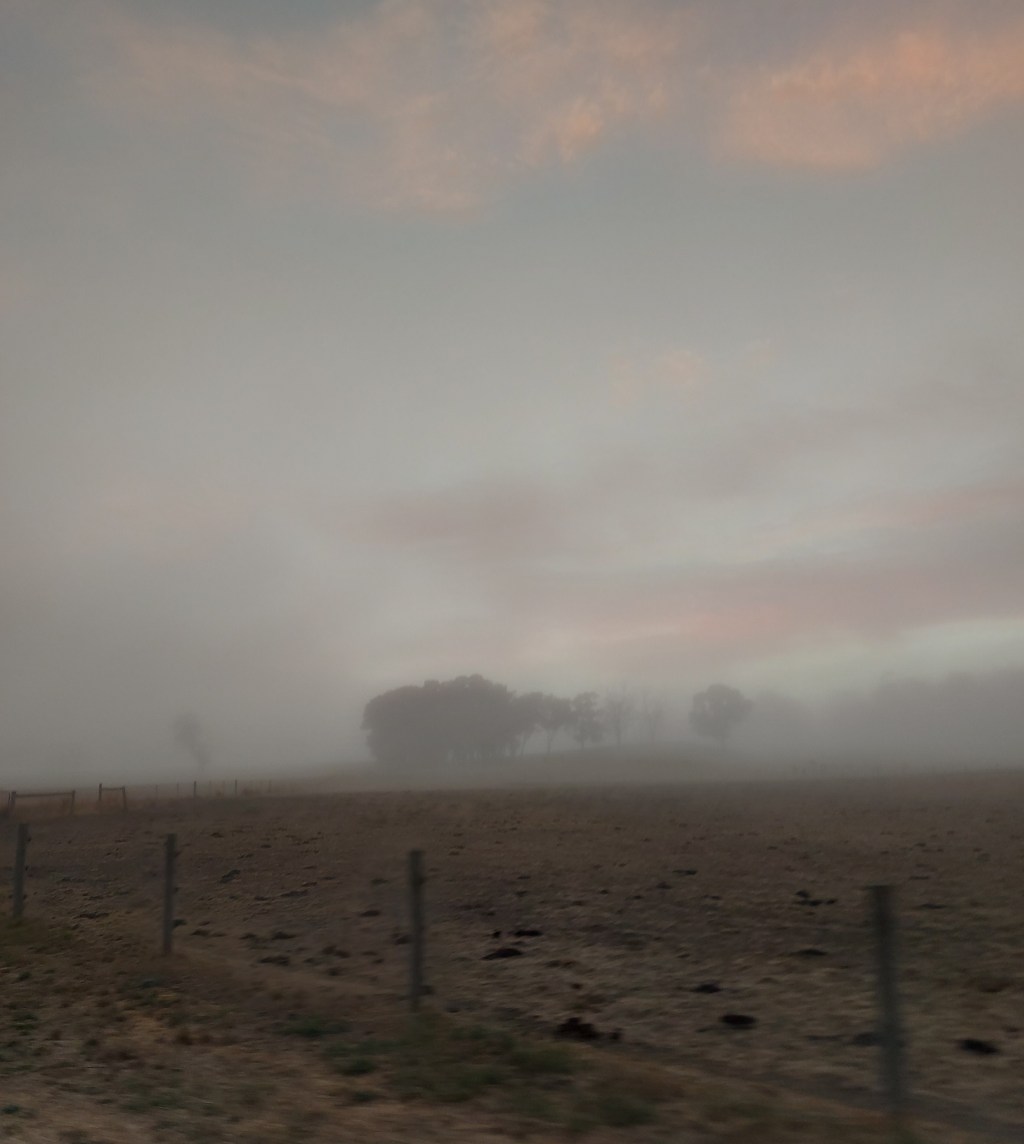
One evening not that long ago, I drove home to the rolling notes of an old song, the glowering sunset behind building rain clouds and the dusty smell of oilskin about me. I reveled (quite pathetically) in the tragic air of these beauties. I’ve become aware that sometimes life makes us feel as if we’d been thrown straight into one of Shakespeare’s tragic comedies. The pain comes alongside the laughter – like a giant wince. Alas, the Great Humourist writes our stories! And I am more convinced than ever that the bard was right – ‘all the world’s a stage’ and we are but actors upon it. Humour is the God-given antidote to self-pity: taking ourselves too seriously is the disease, laughing at ourselves the cure. When we laugh at ourselves, whether outright or in attitude, we live gracious, undeluded lives. Our hearts are no longer muddied springs. The sparks of humour light up the truth and the veil drops – we see clearly for an instant. All our ridiculous scramblings to be better people, more virtuous, more beautiful, more Christ-like, are suddenly so jocular. In light of the Great Comedy that is Providence and in the recesses of the hidden Dressing-room that is Joy, we see the joke – indeed, we are the joke. But it is glorious and weighty, not cruel or vain as some would think.
Yes, we must laugh in life, even if merely inwardly, for laughter is medicine to the sick, sustenance for the soul. Laurence Stern, who wrote The Life and Opinions of Gentleman Tristram Shandy said the following about laughter: ‘Every time a man smiles, – but much more so, when he laughs, it adds something to this Fragment of Life’. Respect for the Divine sense of humour will keep us chuckling along the straight and narrow, asses though we may be. And in case anyone reading this is tempted to think I’m being irreverent, I shall attempt to illustrate my point with an anecdote:
The Anecdote1
It had been a rotten week for George. He’d spent his days in a bad state of mind, brooding over failures, getting stuck in self-pity and ruminating on the fact that he had already ruined his life at 30. This last bit may have been true, but dwelling on it was not going to make it any better. As a result, George had felt off all week – the awful feeling exacerbated in turn by his sense of helplessness and always feeling cold (it was mid-winter).
To add to these tortures, upon driving to church Sunday morning, he nearly hit a dog in the main street. Slamming on the brakes, he narrowly missed catapulting the unsuspecting canine fifty metres down the road. This gave him an instant shot of adrenalin and shocked him into a deceptively serene state, so that by the time he’d taken a seat in his pew, he was visibly shaking. His morning did not improve. The choir sang something which he assumed was supposed to be Amazing Grace (but which would have made John Newton turn over in his grave) and anything anyone said to him annoyed him extensively. He did not attempt to greet people. He did not join in the singing. He was in a foul mood. He even, at one point during the sermon, wished the brimstone of heaven down upon his head but knew that would hardly resolve matters. He’d have to wake up to himself one day, and deep down he would’ve liked to do it while here on earth, rather than face to face with the Creator of the world. And really, who could blame him?
The service finished and people started to mill about as people do at social gatherings. George found this awkward – he did not know what to do with himself – whether to turn to the right or to the left, whether to scratch his nose, or his forearm, whether to feign indifference or pretend to take delight in people watching. It was like one of those horrible in-between moments at parties when groups haven’t yet established themselves and so no one knows where to stand or what to do. Finding himself quite alone, George was hit with an excruciating self-consciousness. And he did the first reasonable thing that jumped into his mind: he panicked and went to hide like a dog with its tail between its legs – in the toilets. This was his means of escape, made worse by the fact that he knew all along what a miserable coward he was. So poor pathetic George actually stood there in the toilet cubicle, chewing his nails, flabbergasted.
‘Come on old boy. This is so sad!’ he muttered to himself. But his feet seemed glued to the floor, and he could not move from his predestined place in the cozy little toilet cubicle. He didn’t even need to go to the toilet though he considered trying to just so that he’d feel less like an idiot. But he drove home instead, escaping unseen and dashing out the door, coattails flying in the draught, before any innocent fellows hailed him for a chat. There was no point prolonging the pain.
Poor George – we all feel terribly sorry for him, I’m sure. For he had forgotten to forget himself. Taking himself too seriously, George began to experience the suffering that comes alongside such a dreadful disease. Thankfully, it wasn’t long before he snapped out of it.
‘I hadn’t had a good laugh for at least a week,’ he told me quite openly over a nice coffee and a chat the other day.
‘I was sitting in bed that night, and – you won’t believe it – but the strangest, most uncanny thing happened. After all my misery, a glimmer of humour. It happened quite suddenly – like the gentle touch of a loving God…’
He finished by grinning audaciously at me. I am glad he finally woke up to himself – many find the experience a lot harder than our George did. And I have no doubt that his ‘glimmer of humour’ came along with the delightful suspicion that God was still putting up with him: spoiled, ungrateful child though he was. But aren’t we all?
I tell this story to show that our wonderfully gracious, steadfast God really does have a sense of humour. Why else would he use such ridiculous creatures to bring about his good purposes in the world? Of course, the sting of this beautiful joke is tempered by other aspects of His character – His love, His patience – but these don’t change the fact that human beings really are quite ridiculous. I half-suspect the angels laugh gladly at us and our bumblings to be good. Yes, we are absurdly sad and sometimes quite pathetic, but in the hands of our Creator, we become angelic, though perhaps only if we learn to laugh well, to forget ourselves.
I have come to discover that pain and joy may coexist in this life. The fullness of God fills – and overflows – an empty vessel. Could it be… and I dare not hope – that it is good to be empty, hard as that is? Yes, I am determined to laugh at the world with my fellow friends, while all around us lies a frowning gloom. People are not happy enough these days. The cares of life are taken too seriously when these are only fogs and mists, destined to lift. Beyond their temporary murk shines the steady Sun – that fiercely loyal friend, smiling face of heaven. Reminds me of those lines from a well-loved hymn: Behind a frowning Providence / He hides a smiling face2
***
One cannot underestimate the importance of the jester, the clown. Life is silly. The great writers knew it. Take Shakespeare’s fools for instance: comic examples of men who stand right-way-up in a topsy-turvy world. We come to see these jesters as the ones who symbolise order, while everyone else runs about like headless chooks trying to fix their own chaotic circumstances. It is the unnamed Fool in King Lear who uses his jokes to reveal the truth about Lear’s bad rule and injustice. Perhaps my favourite literary fool would have to be Wamba from Scott’s Ivanhoe. Wamba with his little belled hat, his unconscious self-sacrificial disregard for himself to save his master; Wamba, with his pathetically jolly and desperate truce-cry of ‘Pax Vobiscum’.
These literary characters display perfectly the nature of Humour: a little bit goes a long way – too much will spoil the brew, but a generous pinch (maybe even a handful of the stuff) will help in trouble, straighten what is crooked, and cut away the cataracts3.
Of course, not everything we experience is funny, but much of it is or can be made to be with a little imagination. Chesterton thought about this enough to write that we were ‘permitted tragedy as a sort of merciful comedy… Joy is the gigantic secret of the Christian,’ he says. Sadness is the anomaly, joy the reality. Joy can never be unusual and abnormal because it is the foundation of Heaven itself. We are more ourselves, more human ‘when joy is the fundamental thing in us and grief the superficial…’
Nevertheless, while in this life we are joyful softly. We dare to laugh quietly, shyly, because those mists hang about us still. But when we finally get to that fair City, the mirth of Heaven shall ring out, and we’ll understand why it had to be the tempered chuckling here on earth. Perhaps (as Chesterton so elegantly puts it) the laughter of Heaven was too loud for us to hear.
Author’s Acknowledgements
I’d like to thank my friend Tristram Shandy for inspiring this essay, and for helping me to see the stupidity of life – to get on with it in true shandy style. I do believe, as he once said himself, that we may do just about anything ‘by mere shandyism’. Also, to Spurgeon, the illustrious Matthew Flinders, his cat Trim, and other great men of old (and their animal companions4) too numerous to mention here – I drop a curtsey and thank you all for being the shining, endearingly faulty examples that you were. Where we would be without you, I do not care to fathom.
1Names and place names have been changed to protect the privacy of certain individuals featured therein.
2These lines were written by English poet and escapist William Cowper when he was in the throes of depression – a timely reminder that sorrow is certainly not THE thing in this life, but a mere passing shadow: ‘there is light and high beauty forever beyond its reach’ – as Sam Gamgee whispers to comfort himself when he is looking after Frodo in Mordor: wise and wonderful words from one of the world’s most charming creatures, the Hobbit.
3I beg your pardon, dear reader, for this awkward metaphor about cataracts (you are being very kind and persevering to have read this far.)
4I think it was William Wilberforce who kept a pet hare


Leave a Reply